Over the past couple of weeks I have been reading a biography of C.S. from the public library written by Michael White. I was assigned the reading of a secondary source perspective on C.S. Lewis' biography by my professor, who seems to be of the opinion that I should write my undergraduate thesis on this man, whose writin I connect to so much. However, I have to admit that after reading this particular biography, I don't know if I do want to write a thesis on this man.
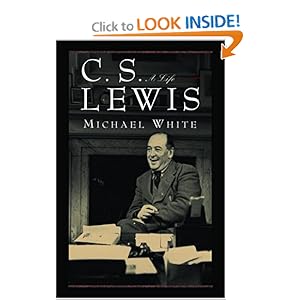 One thing that has always attracted me to the person of C.S. Lewis is that I connected with his writing. He writes in a way that is very relevent to how I think: linear, rational, and yet imaginative and witty. This particular book, but it also made me feel completely disillusioned with the man C.S. Lewis was, in fact, it almost makes me want to dislike him. The author represents Lewis as a bigoted snob, who didn't really have time for technology, progress, children or women, and who is deeply scarred and bitter over experiences that happened over his childhood. While I understand that all of these things were certainly a part of the human that C.S. Lewis was, I really detest how the author not only presented, but speculated on the information with his own personal bias.
The thing I dislike most, I guess, in this book, is how pitiable the author made C.S. Lewis out to be. He presented the humaness of C.S. Lewis to the point of making his seem pathetic. One particular way he did this was by painting C.S. Lewi's faith as a crutch, which although was certainly very helpful and important to C.S. Lewis, was not really worthy of any major notice. In contrast, the author spent almost a whole chapter ruminating on whether Lewis had sex with a particular women whom he lived with for a long period of time and called mother (she was the mother of one of Lewis' best friends who was killed in the war). He spend a great deal of time focusing on Lewis' fantasy literary career but tries to brush over most of his religious works with a short description.
Once again I find myself struggling with the fact on how popular literature can actually write about a person whose faith became so integral and central to their life and fail to provide any detail on how that actually worked, other than that faith being a crutch. On the positive side, I did glean some valuable information from this book - such as certain events and people who influenced C.S. Lewis' life - and I also appreciated how this author went out of his way to present C.S. Lewis as a human being and not some glorified uber-Chrisitan, but at the same time I feel like I must take even this portrayal of Lewis with a grain of salt. I understand that the author is an athiest and that every writer must have their bias, but if I were to use this book as a judge of C.S. Lewis' character, I probably would never read another one of his books again.
Once again I find myself struggling with the fact on how popular literature can actually write about a person whose faith became so integral and central to their life and fail to provide any detail on how that actually worked, other than that faith being a crutch. On the positive side, I did glean some valuable information from this book - such as certain events and people who influenced C.S. Lewis' life - and I also appreciated how this author went out of his way to present C.S. Lewis as a human being and not some glorified uber-Chrisitan, but at the same time I feel like I must take even this portrayal of Lewis with a grain of salt. I understand that the author is an athiest and that every writer must have their bias, but if I were to use this book as a judge of C.S. Lewis' character, I probably would never read another one of his books again.

No comments:
Post a Comment